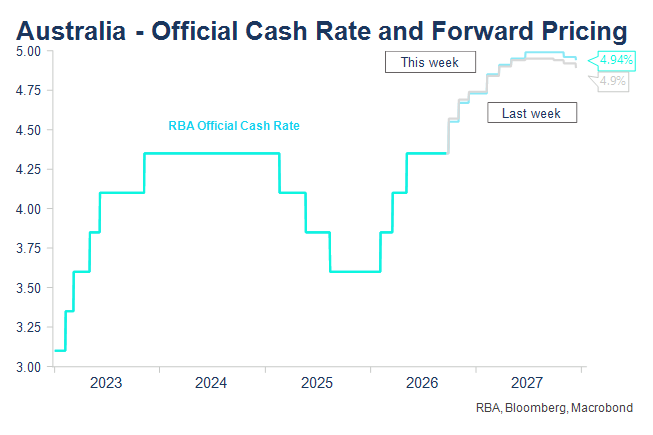
RBA and Federal Reserve both likely to raise interest rates for a second time before Christmas after September moves as concern over inflation rises.
Key points
- A very hawkish RBA Parliamentary Testimony suggests high risk of a quick second rate increase in November or December after what is expected to be another elevated trimmed mean CPI in Q3.
- Of particular interest in the RBA’s Semi-Annual Testimony to Parliament was the suggestion that inflationary expectations were beginning to de-anchor. Businesses are increasingly reporting to the RBA that the Bank will not get inflation back below 3%! This argues against the highly likely September increase next week as being a one-off. A follow-up rate rise in November is now my base case.
- The US Federal Reserve’s September rate rise is likely to be the first of three increases in this phase of tightening. A second rise is likely to be delivered in late October. Tightening cycles rarely begin with a stand-alone move, while an October move provides optionality for a further increase in December.
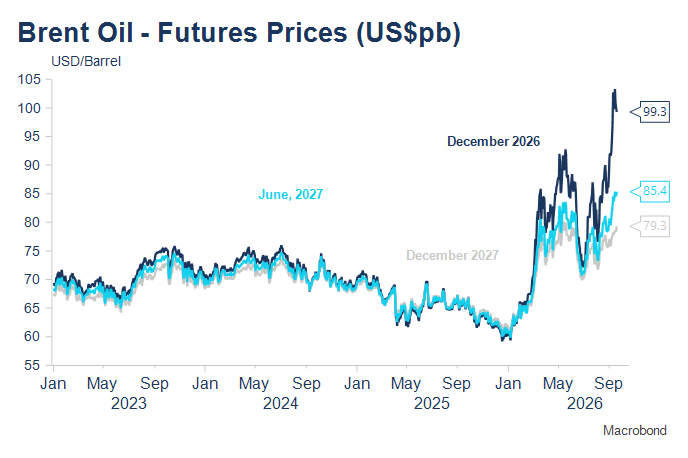
- Oil prices have had a more limited impact on bond markets this week but are likely to boost headline inflation prints in September and October given higher petrol, diesel and jet fuel prices. Australian petrol prices are likely to rise around 15% in August and a further 8-10% in September, while domestic airfares for the coming school holidays are also very elevated. On the flip side, there seems to be considerable discounting for non-electric vehicles, while BYD is reportedly discounting some new vehicles by 25%!
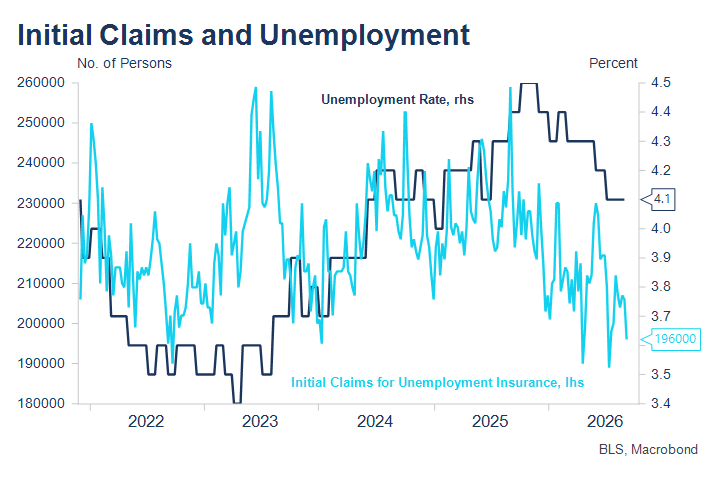
- In a quiet week for statistics, August Labour Force data on Thursday is the key Australian statistic, while in the US, it’s very much second tier data. Initial jobless claims is worth a look after dropping to a very low 196,000 last month and after having correctly signalled lower US unemployment over the past year.
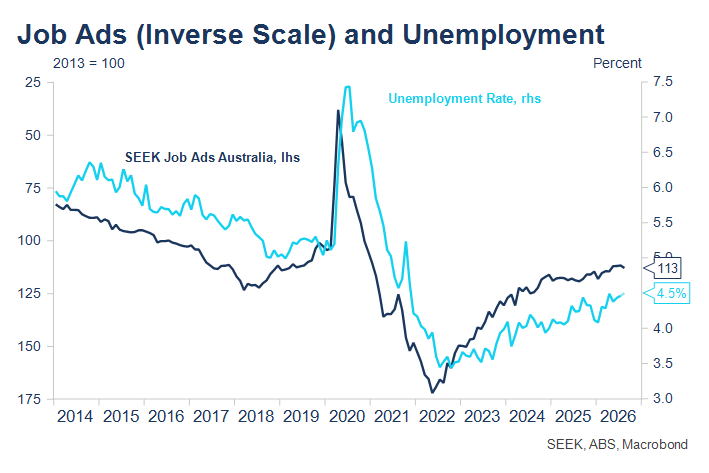
- After last month’s labour force results, the risk seems to be on the high side for the market’s forecast of employment (+20,000) and the low side for the forecast of unemployment 4.5%. SEEK job ads, which recorded the first rise since April (+1.1% in August), are not signalling any significant deterioration in the Australian labour market, which the RBA continues to assess as a little tight, allowing the Bank fuller focus on lowering inflation.
- There are lots of RBA and Federal Reserve speeches this week, with three RBA speakers on Tuesday. The messages from RBA staff are unlikely to differ much from recent utterances, so there will be interest in the first public appearance of external Monetary Policy Board member Iain Ross.
- In the US, there’s a veritable deluge of speakers on the calendar. My interest will be on whether there are any indications of a quick-follow up rate rise in late October., which is now my base case. Kashkari sounded in that camp overnight, though he has been a hawk, dissenting in July in favour of an immediate rate increase.
- Treasurer Chalmers also releases the latest Intergenerational Report at 12.30pm today. The press had a number of leaks over the weekend and today. The continuing 1.2% productivity assumption over the next 40 years is likely to prove controversial and = drive considerable debate – and rosier trends! The actual level of productivity growth and impact of AI over the next forty years is unknowable. Hopefully, the IGR provides scenarios under high, medium, low and very low productivity growth assumptions or the document will be largely ignored.
Key developments over the past week
While data was relatively light on the ground, it of course was a very big week for the US Fed and the RBA. Oil prices were less of an influence on bond markets but remained very elevated. The Fed and the RBA both spoke of the need to ensure that the resulting cost and price pressures did not become more widespread.
The main developments included:
- The FOMC voted unanimously to raise US interest rates 25bps, as we had expected. A large majority of Committee members also indicated a likely second rate increase before Christmas with a slim majority expecting one further increase next year. Many forecast unchanged interest rates in 2027, though four members are pencilling in rate cuts next year, including one member that forecasts four interest rate cuts.
- The comments in the press conference explaining the reasons for the tightening – which included the US labour market being at full employment, the US economy having strengthened, and the AI investment boom being short-term inflationary – remain consistent with my expectation of this phase of tightening totalling three interest rate rises (and of the continuation of a long, slow tightening cycle, which is typical of many investment booms).
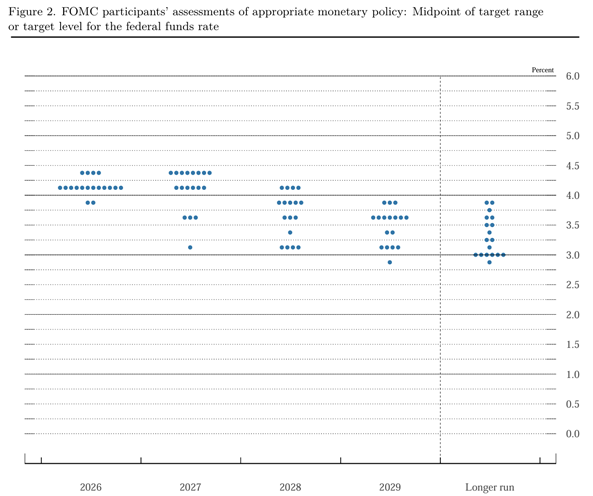
Source: Federal Reserve
- The RBA continues to prep the market for an interest rate rise in September, with appearances at the beginning and end of last week that maintained their recent very hawkish communications. These all but guarantee a rate rise at the September Board meeting next week but raise the probability of another near-term rate increase at either the November or December Board meetings.
- Job ads are one of my two favourite indicators of the Australian economy. This month’s result from SEEK, job ads increasing 1.1% in August, bears close monitoring as were the trend to continue it would likely signal lower unemployment and higher interest rates.
RBA Semi-annual Testimony and the prospect of back-to-back rate rises
On the back of the RBA’s semi-annual testimony, I have revised my RBA view to two interest rate rises before Christmas. My base case is moves in both September and November. The change reflects the considerably more hawkish nature of recent RBA communications about inflation beginning with Deputy Governor Hauser’s “people are furious about inflation” comment. The Semi-Annual Testimony continued with more vociferous comments about the importance of returning inflation to target. As in the US, this focus is possible because the labour market is still assessed to be a little tight. And very importantly, the Governor also noted that businesses’ inflationary expectations might be beginning to de-anchor with firms increasingly reporting to the RBA that they do not believe the Bank will get inflation back below 3%.
The change in the nature of the RBA’s communications, firms’ increasing inflationary expectations, and oil prices remaining elevated for longer than previously expected all suggest that inflation might remain above-target for an even longer period unless some further policy tightening occurs. These developments suggest an even softer period of demand growth is necessary, which argues against just one further near-term interest rate rise being delivered.
The Board will have the Q3 trimmed mean CPI (expected to continue to run at a considerably above target 0.9% to 1% q/q) and a full set of new staff forecasts to consider in November. While it’s only a month from the September meeting, if the Board hopes to have any impact on the track of inflation by the second half of 2027, it needs to move quickly, supporting the likelihood of a second interest rate rise before Christmas. That said, it seems unlikely that Australia will need a third very quick move as our economy remains more geared to sort end moves. I continue to expect no early interest rate cuts while the AI investment boom phase continues.
Australian and US key events calendar
All times shown are AEST.
Monday 21 September
- 12:30pm Treasurer Chalmers releases Australia’s 2026 Intergenerational Report
- 08:30pm Fed’s Goolsbee speaks
Tuesday 22 September
- 05:00am RBA’s Hunter podcast released
- 01:00pm RBA Governor Fireside Chat
- 05:30pm RBA Board member Iain Ross speaks at the University of Melbourne
Wednesday 23 September
- 00:05am Fed’s Williams speaks
- 00:20am Fed’s Jefferson speaks
- 03:00am Fed’s Barkin speaks
Thursday 24 September
- 00:05am Fed’s Barr speaks
- 11:30am Australian Labour Force (August). Employment expected +20,000, previous -15,800, risk high side; Unemployment expected 4.5%, previous 4.46% (risk low side)
- 06:10pm Fed’s Williams speaks
- 10:00pm Fed’s Barkin Fireside Chat
- 10:30pm Initial Jobless Claims (previous 196,000)
- 10:50pm Fed’s Hammack speaks
Friday 25 September
- 07:15pm Fed’s Williams speaks
- 10:30pm Durable Goods Orders (August) (Ex-transport expected +0.6% m/m, previous +0.4% m/m)
- Midnight University of Michigan 1-yr inflationary expectations (previous 4.6%); 5-10 Yr inflationary expectations (previous 3.4%)
Saturday 26 September
- 00:10am Fed’s Paulson speaks
- 04:00am Fed’s Hammack speaks
There are not that many significant economic releases in the US or Australia this week, with the key focus being Australia’s Labour Force data on Thursday. Tuesday is a busy day for RBA commentary (the last before the blackout begins ahead of next week’s Board meeting). The RBA is unlikely to sway from recent very hawkish inflationary commentary, leaving focus on the speech by external Monetary Policy Board member Iain Ross. It’s unclear whether the speech will be policy relevant.
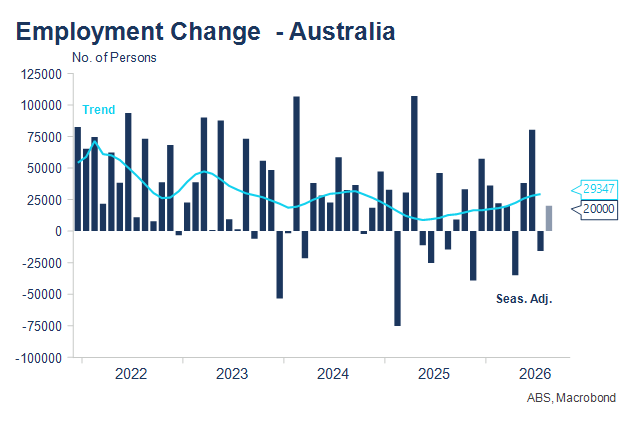
The monthly Labour Force data is always highly influential but also highly volatile. Recent months have seen added volatility as the Australian Bureau of Statistics modernises the survey. Last month’s “weak” employment print followed a very strong rise of 80,000 in June. This is likely behind the modest +20,000 median forecast for the month, suggesting the risk is likely on the high side. With the unemployment rate just creeping over a rounding barrier to 4.5% last month (4.46%) and with the market forecast already at 4.5% and job ads improving in August, there seems more downside than upside risk this month.
In the US, there’s mainly second tier housing and regional Fed manufacturing and services surveys. Initial jobless claims on Thursday are worth a considered look after dropping to 196,000 last week and may be a signal that the strengthening in payrolls growth signalled by the NFIB series has begun. The declining – though volatile – trend for jobless claims has correctly signalled lower US unemployment over the past year.
Different to most weeks since Warsh took over as Fed Chair, there is a deluge of Fed speakers. Of interest will be any comments supporting my view that a further interest rate rise is more likely to be delivered at the end of October meeting, as opposed to the December meeting. The revised dot plots clearly signal a likely further US interest rate increase before Christmas.
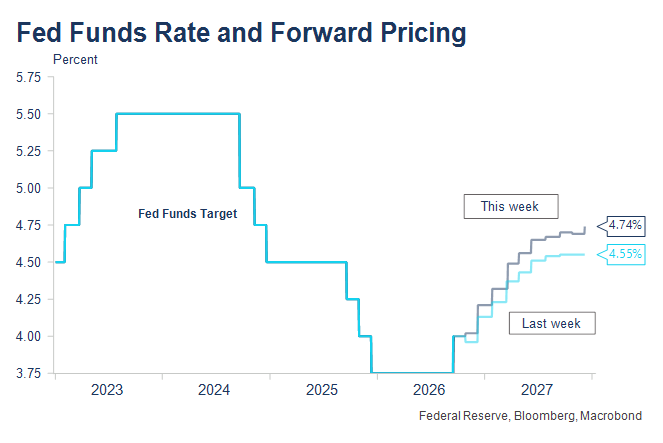
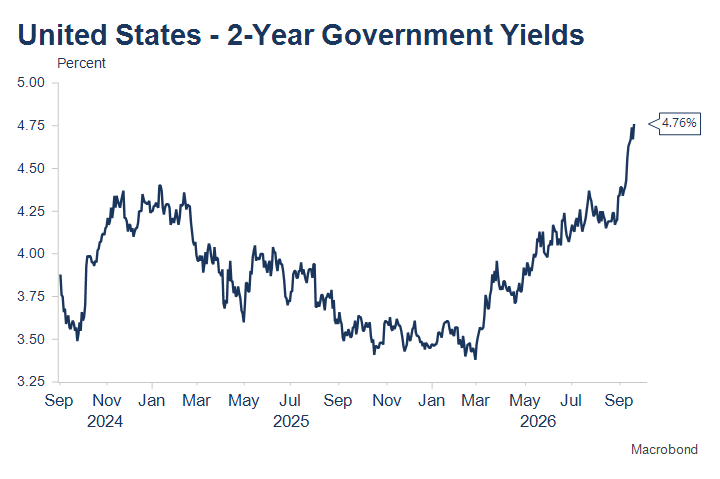
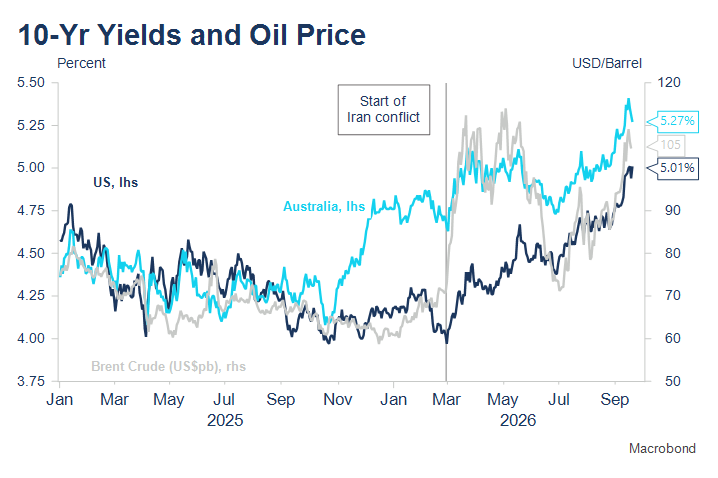
For the second week in a row, US markets added nearly a full further interest rate rise into their forward pricing. Bond markets initially sold off on the interest rate rise, before rallying back on Thursday. After more fully digesting the hawkish message of the Fed, bond yields sold off further on Friday. Markets now attribute just over a 50% chance of a move in October, but a 137% chance of a tightening in December (or alternatively, discounting nearly one and a half moves by that time). I favour a quick follow up move to occur in October, giving the Fed optionality for a third move in December if considered necessary. The commencement of a tightening cycle rarely occurs with a stand-alone move.
Outlook
My base has been the emergence of a long slow tightening cycle in both the US and Australia, driven by the AI investment boom. This leaves me modestly bearish on bond yields in both countries and trading from a sell rallies rather than buy dips perspectives. The past week has seen more significant repricing of the US short end than the Australian short end, helping Australian bonds outperform. That said, Australian shorter and longer-dated yields have still been dragged notably higher over the past two weeks by the combination of Fed repricing and more hawkish commentary from the RBA.