NFIB signals downside payrolls surprise but stronger payrolls ahead. RBA expected to hold but markets continue to underprice likely tightening by Fed and RBA.
Key points
- The Governor’s Anika speech highlighted the Board’s job in coming months would be to determine whether policy was sufficiently restrictive to return inflation to target.
- Following the lower than expected Q2 CPI and weakness in housing markets, the RBA is seen almost unanimously as holding interest rates unchanged at this week’s August Board meeting. The chance of a surprise rise, however, is higher than the 0% priced by markets.
- While I expect no change at this meeting given recent communications and near-term changes to forecasts (unemployment up, inflation marginally lower, growth unchanged), I continue to expect that some further tightening will be required to return inflation to target, given ongoing elevated wages growth. That’s likely to become clearer in the next few months.
- As such, the communications from the Governor in her press conference along with updated RBA staff forecasts are key; both of which will allow the market to assess the probability of further tightening being required. The RBA Board is likely to continue to warn that it will not hesitate to tighten further if required.
- Apart from all the RBA action from 2.30-4.15pm AEST on Tuesday, there’s a fireside chat with Assistant Governor Kent on Thursday and the RBA’s semi-annual testimony to parliament on Friday morning.
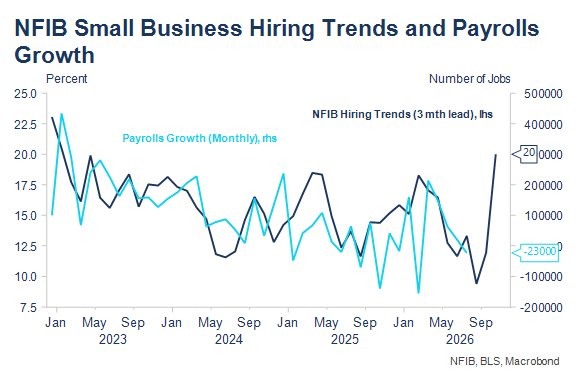
- Non-farm payrolls growth surprised to the downside in July, causing interest rate markets to reduce the chance of the Fed tightening in October and November, but a hike remains fully priced by year end.
- The softness in July was again signalled by the NFIB series, however, that series bounced back very strongly this month, suggesting stronger payrolls growth lies ahead. That keeps the Fed firmly in play in coming months, given inflation remains elevated and the AI investment boom continues. Other employment indicators I follow have also generally bounced back, suggesting the recent weakness reflects the impact of mostly temporarily elevated oil prices in March through May.
- The NAB Business Survey is the main Australian economic event of the week outside of the RBA. Like the US ISM surveys, it’s close to a real time update on the economy. Key will be whether business conditions bounce back given somewhat lower oil prices and whether the very strong reading for construction conditions is sustained in July, suggesting a significant underpinning to the economy from the sector, in part due to data centre construction. The regular price and cost pressure indicators are relevant for any early read on inflation pressures in July, while capacity utilisation has a useful track record for interest rate direction and has been elevated in importance given the RBA’s capacity-constrained narrative of the Australian economy, which seems more narrowly based than the RBA suggests.
- In the US, the CPI on Wednesday is the main event as Chair Warsh continues to verbally commit that the Fed will deliver prices stability. The FT during the week reported that Warsh will continue the new policy of limited Fed communication and that he would tighten in September if upcoming inflation readings surprise to the upside. The risk for US CPI and retail sales appears to be a little to the high side this month given likely supports from the FIFA World Cup.
RBA preview
The RBA is almost unanimously expected to leave interest rates unchanged at this week’s August Board meeting, with no chance of a rate increase priced by markets. While my expectation is also for no change in interest rates at this meeting, zero chance is a little low! The key issue then is expected to be not the decision itself, but whether the Board’s updated forecasts and communication suggest greater prospect of modest further tightening later in the year than is currently priced. At this stage markets price less than a 50% chance of a further tightening by December, and a peak probability a little below 60%. While I’m not suggesting at this stage that a lot of further tightening is needed, my base case remains of some modest further tightening later in the year as inflation is not expected to show sufficient progress back toward target given current rates of wages growth and resultant sticky services inflation.
Background
- The RBA Board meets on Monday and Tuesday this week, with the Board’s interest rate decision of course to be released at 2.30pm AEST on Tuesday.
- RBA staff will present the Board with updated forecasts on the outlook for the economy, unemployment and inflation. These forecasts are simultaneously released at 2.30pm AEST in the August Statement on Monetary Policy.
- Since the May forecasts were put together:
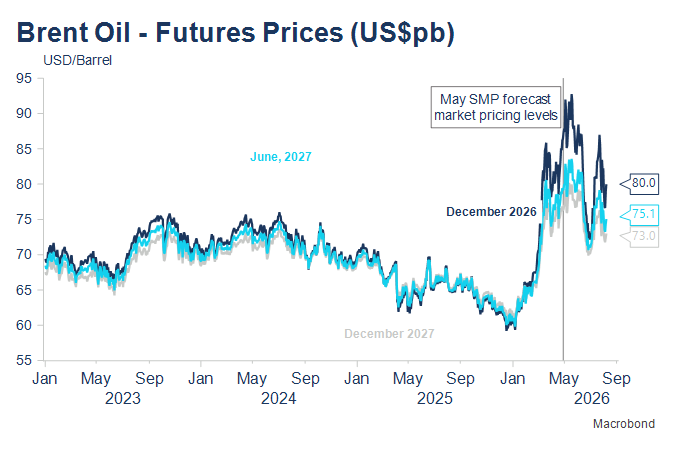
- The Middle East conflict – and, more importantly for the RBA’s view of inflation, oil prices – have ebbed and flowed and most recently, have ebbed again. That is broadly in line or slightly better than the RBA assumed in May.
- The unemployment rate has risen more than the RBA expected printing at 4.4% in two of the three months of the June quarter compared to a 4.2% expectation in May.
- The Q2 trimmed mean inflation rate at 0.8% q/q was a little lower than the RBA was expecting. While welcome news, this is still a rate of inflation that if sustained in coming quarters, would be seen as inconsistent with a return to the RBA’s 2.5% inflation target.
- Housing market turnover and prices have weakened somewhat more than expected, in part due to changes to government taxation settings in the May budget, which post-dated the RBA’s May forecasts. The RBA does not target house prices but considers the flow-on effects of house price changes through wealth effects and related consumer spending. Changes in house prices are often considered an indication that monetary policy is restrictive (or accommodative), as the case may be, though part of recent developments reflect tax changes.
- The outlook for parts of construction has strengthened on the back of very strong AI data centre spending and approvals.
- The Minutes to the previous Board meeting in June and recent speeches continued to warn that the RBA Board would not hesitate to raise interest rates further if it felt that this was needed to ensure inflation moderated to 2.5% in a reasonable timeframe.
- With the latest Middle East shock, the RBA’s May forecasts anticipated it would take a further 18-24 months to return inflation sustainably to target, which if realised, would mean inflation above target for nearly six years.
- The Governor and Assistant Governor, Economic Hunter have both given important speeches in recent weeks, noting the economic developments described above, with Hunter continuing to sound concerned on the inflation outlook.
- The Governor’s speech arguably provided the two most important insights into the perspective of the RBA as it approaches the August Board meeting. The Governor noted that the key task for the Board in coming meetings would be to determine whether policy was restrictive enough to return inflation to 2.5%, while also noting that it was too soon for the previous tightening in policy to have had its full effect. Both suggest that a move at this meeting is a little premature.
- Together with the additional effect on the housing market from budget taxation changes, this has led many economists – including the economists from each of the four major banks – to conclude that the Australian official interest rate has now peaked, with some modest interest rate reductions possible from around the middle of 2027.
- In an unusual occurrence, there is also a sizeable group of Australian economists that continue to forecast that some further tightening of monetary policy will be required to return inflation to target.
- I belong to that latter group, assessing that the continuing low level of unemployment, the 4.8% minimum award wage increase and general 3.5-3.75% rate of wage increases and resultant sticky services inflation mean it is very unlikely that the inflation rate will moderate as forecast without some further policy restriction.
- With the RBA having raised rates three times in quick succession in the first half of the year, and the additional slowing impetus from weaker house prices and housing turnover, my expectation is that the RBA will continue to monitor the economy for a while longer, before this becomes more apparent, perhaps in September or November.
- As a result – and as now widely expected and priced by markets – no change in interest rates is expected at the August Board meeting. Key focus will be on the accompanying communication:
- Did any of the non-RBA Board members dissent in favour of further tightening at this meeting? Implicitly suggesting that either policy was not yet sufficiently tight to be confident that inflation would moderate to 2.5% in 18-24 months or that waiting a further 18-24 months to return inflation to target was no longer considered a reasonable timeframe after such a long period above target.
- How have the RBA staff’s forecast on unemployment, growth and inflation changed? The forecasts seem quite sensitive to the latest data point, often a sign that models lack stability. An upward revision to the unemployment forecast and some improvement in the inflation forecast are expected, though the minimum wage adjustment will work to limit the improvement in inflation forecast. Growth should be little changed as stronger construction spending and less assumed tightening offset weaker housing turnover and related wealth effects.
- The message of the Decision Statement and how the Governor portrays the discussion of the Board in her subsequent press conference. Presumably this will repeat the message that the Board remains ready to tighten interest rates further if that is required to sustainably return inflation to target.
The arguments for an interest rate cut at this meeting
- The only conceivable argument would be the spreading weakness in Australian housing markets.
- My interpretation is that the RBA would see this as assisting the return of inflation to target rather than a possible reason to cut interest rates, especially after the Board had to quickly reverse the interest rate cuts of 2025.
- I do not expect this option to even be considered at this meeting.
The arguments for leaving interest rates unchanged at this meeting
- Inflation forecast revisions likely to have been a little “favourable” and unemployment forecast revisions “unfavourable”.
- Together with the full effects of earlier tightening still to play out and the additional drag on the economy coming from weaker housing turnover and prices, the Board has more time to assess the impact of the prior tightening on the economy and inflation, before needing to enact further tightening.
- This is the strongly favoured argument by markets and myself at this meeting.
The arguments for increasing interest rates further at this meeting
- I expect this option to be considered by the Board in part because the previous forecasts and the August forecasts will both include the technical assumption that some further tightening is required.
- The main argument would be that inflation continues to run around 0.75-1 percentage points above target and the length of time above target has already been too long. Some further tightening would provide extra certainty for the Board that inflation would return to target in a reasonable timeframe.
- Such a move would also help to ensure that inflationary expectations and wages demands do not adjust sustainably higher given the even more extended period of time that inflation will remain above target.
- While the recent RBA speeches provide some insight to how RBA staff will present at the Board Meeting, we don’t have much insight into the thinking of the seven non-RBA members of the Board, some of which may understandably be becoming more concerned about continuing above-target inflation.
Conclusion
No change in interest rates is likely at the August Board meeting. The RBA is likely to continue warning that further tightening will be implemented if required, but the need for any additional policy restriction is unlikely to become clear before the September or November Board meeting. Markets continue to price a mild tightening bias.
Australian and US key events calendar
All times shown are AEST
Tuesday 11 August
- 11:30am NAB Business Survey – July
- 2:30pm RBA Cash Rate Decision and Statement on Monetary Policy
- 3:30pm RBA Governor’s Press Conference
Wednesday 12 August
- 11:00am $1bn 4.25% 2036 bond auction
- 10:30pm US Core CPI July (0.2% m/m; 2.5% y/y expected; previous 0% m/m; 2.6% y/y)
Thursday 13 August
- 10:15am RBA Assistant Governor Kent Fireside Chat
- 10:15pm Fed Hammack Speech
- 10:30pm US PPI – July
- 10:40pm Fed Barkin Speech
Friday 14 August
- 09:30am RBA Semi-Annual Testimony
- 11:00am $1bn 1.75% 2032 bond tender
- 11:30am Housing Finance – June Quarter (-5.3% q/q expected)
- 10:30pm Advance Retail Sales July (headline expected +0.1% m/m, previous +0.2% m/m; ex autos and gas +0.3% m/m expected; previous +0.4% m/m)
- Midnight – University of Michigan 1 year inflation expectation 4.2%; 5-10 year expectation 3.3% - unchanged from previous readings)
Interest rate market developments over the past week
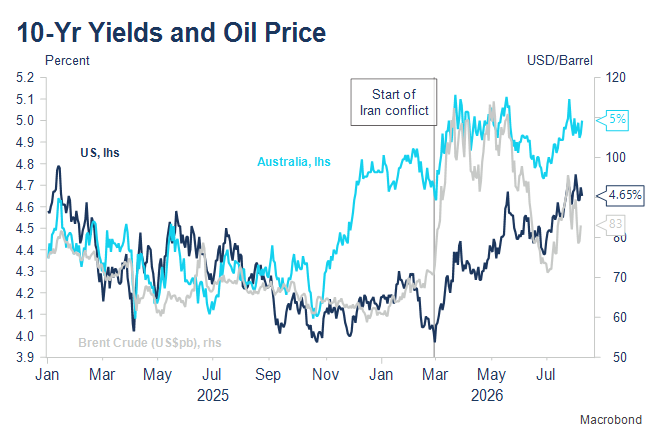
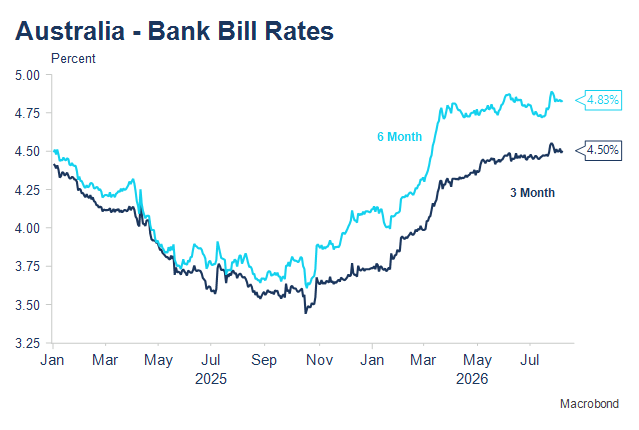
Bond yields and central bank pricing expectations continue to be impacted by the cocktail of oil prices, employment, the AI investment boom and above-target inflation starting points. This week, while the Middle East situation settled and oil prices eased a little further, it was the weaker than expected non-farm payrolls result for July – itself likely a product of previous higher oil prices – that saw US yields correct lower as the markets reduced near-term pricing for Fed rate increases. That said, the market ultimately ended up only 3bps lower in yield on Friday after payrolls, perhaps reflecting some of the leading payrolls’ indicators, but also likely as there was some overstated weakness this month. One rate increase remains priced before the end of the year.
My base case remains of long slow tightening cycles emerging in the US and Australian rate markets as often occurs during investment booms.