
RBA rate rise a done deal. Key is any indication of a near-term follow-up increase. In the US, stronger labour market data will maintain a bearish influence on bond yields.
Key points
- It’s a huge week coming up with the RBA Board Meeting, August Australian CPI and US PCE deflator, numerous Fed officials speaking, and the September Manufacturing ISM. The week ends with the always important US non-farm payrolls and unemployment rate release on Friday night, while the RBA also publishes its latest Financial Stability Review.
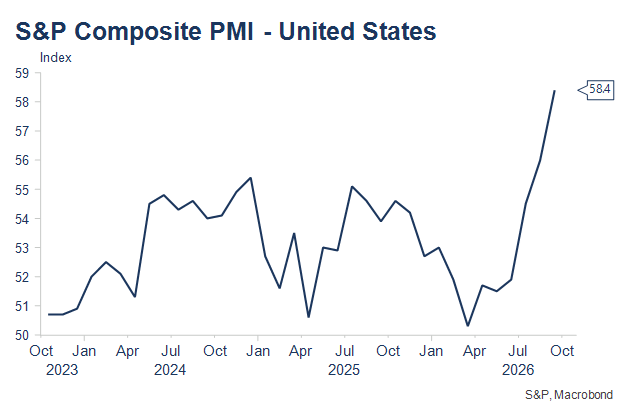
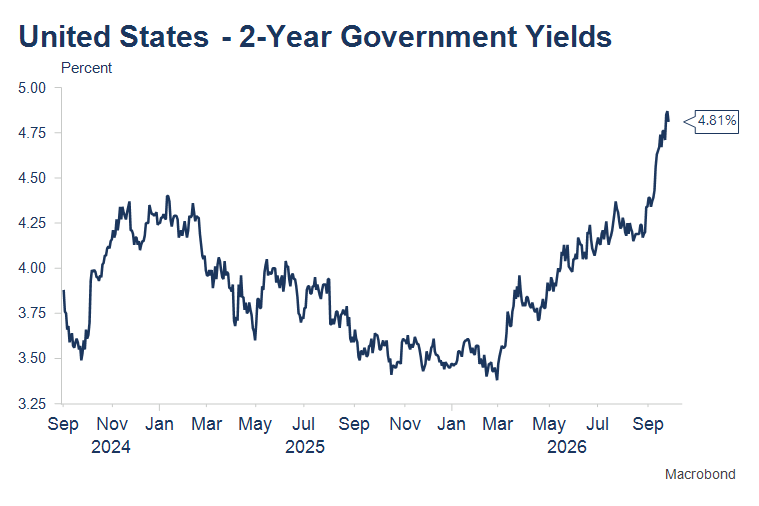
- Bond markets continued to sell off over the past week. Fed commentary was hawkish, while US PMI data for September surprised to the high side. This not only supports Fed Chair Warsh’s assessment that the US economy had strengthened since June but suggests further strength lies ahead.
- I consider an interest rate increase by the RBA on Tuesday as a done deal. My focus will be on the degree of hawkishness and any messages in the Governor’s subsequent press conference that give an indication of the likelihood of a quick follow-up rate increase in November or December. Recent RBA staff pronouncements suggest that’s the risk. The Trimmed Mean Q3 CPI is likely to be high enough to support the Board ratifying a still tighter setting for policy at one of those meetings, however market pricing sees a more gradual response with a second increase not fully priced until February.
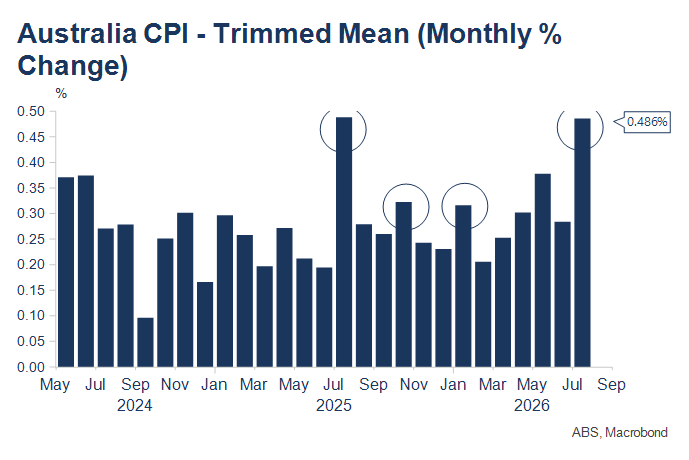
- Apart from the RBA, the August CPI is the main Australian event. A lower outcome than July’s surprise 0.5% m/m is very likely, as there seems to be some seasonality in the monthly CPI that sees the outcome for the first month of the quarter noticeably higher than the second and third months. Ordinarily that might suggest some downside risk to the market forecast for +0.3% m/m. However, oil and diesel prices rose substantially from mid-July to end August, which reduces the downside risk and opens upside risk, though that might not crystallise until September. Either way, the Q3 CPI will be impacted.
- The end of the week sees the release of the latest US non-farm payrolls data, usually the most market sensitive indicator released in the world each month. The NFIB series suggests some strengthening in US employment growth in coming months, while jobless claims suggest the US unemployment rate should remain around 4.1% or fall. That’s likely to see the Fed tighten again at the late October FOMC meeting.
- Core US PCE inflation, if realised at 0.3% m/m in August, would continue to fail Chair Warsh’s requirement that inflation clearly be trending back to 2% in a timely fashion. Comments from Fed officials last week emphasised a greater focus on inflation with the labour market sound and increasingly recognised the demand-driven inflation sourcing from the AI investment boom.
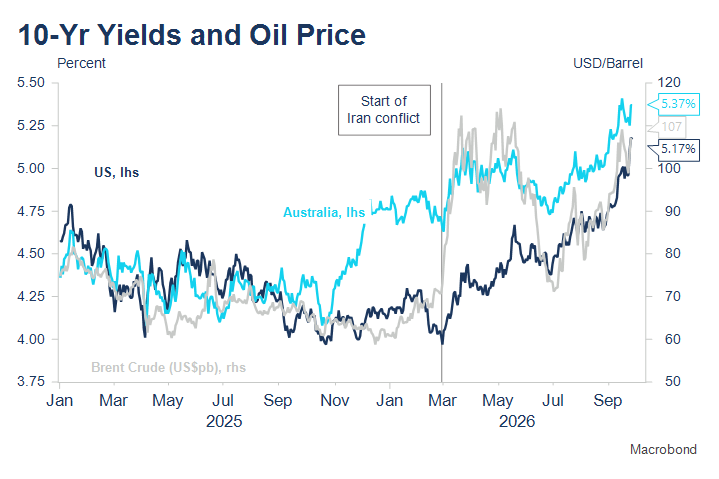
- I have remained bearish on bonds in recent weeks with little progress toward a Middle East resolution and further room for the US and Australian short ends to reprice likely near-term monetary policy expectations on account of stronger US growth. More reasonable monetary policy paths over the next year are now priced but probably still have some way further to run, especially as the Fed is still not fully priced for a follow up interest rate rise in October. Longer-term yields have sold off somewhat faster than I expected as the market comes to the realisation that the AI investment boom will lead to a more extended tightening cycle. The risk is that higher longer-dated US yields continue to drag Australian term yields higher over the medium-term. Any deal to reopen the Strait of Hormuz would likely lead to a short-term countertrend move.
Key developments over the past week
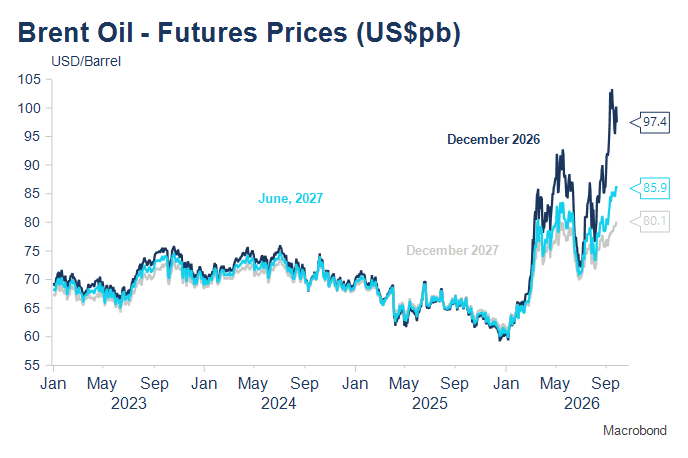
- Oil prices were again less of an influence in the past week but remain very elevated. Over the weekend there were some proposals from Iran to reopen the Strait of Hormuz, but these were rejected by President Trump. At the end of last week, longer-dated futures prices continued to shift bearishly, while nearer-term prices improved slightly. All remain at close to the highest levels since the conflict commenced.
- US interest rate markets continued to reflect a more significant US monetary policy tightening cycle. Nearly four interest rate rises are now priced by mid-September next year.
- The S&P Composite PMI for the US was much stronger than expected in September and suggests US economic growth continues to strengthen (we’ll get an update on the Manufacturing ISM on Thursday night). The pricing component remained very elevated. Both developments suggest the Fed has more work to do, though the market is not fully pricing the next tightening until December. It’s quite rare for the Fed to commence a tightening phase without back-to-back increases, so I continue to look for the next move to occur at the late October FOMC meeting. This also leaves the FOMC optionality for a further move before Christmas.
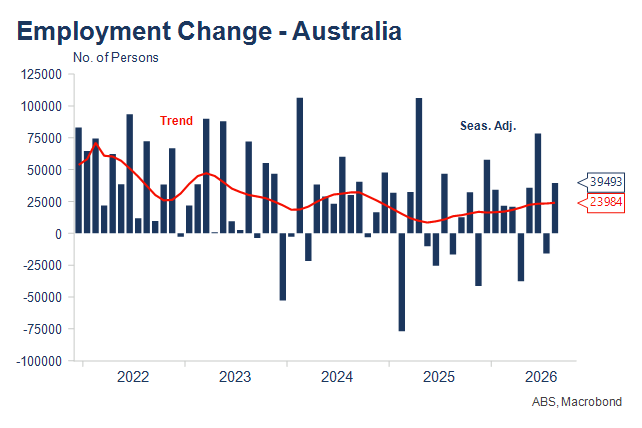
- Australian labour market data contained two surprises last week: employment growth was nearly double expectations at +39,500. There was a contradictory move in the unemployment rate, which jumped from 4.5% to 4.6% and was within a whisker of rounding to 4.7%.
- The ABS has been modernising the labour force survey and some technical changes likely artificially boosted the unemployment rate this month. If last year’s August unemployment seasonal adjustment had been used, the unemployment rate would have remained at 4.5%.
- I expect this effect to reverse next month. The RBA will likely conclude the outcome is more signal than noise and in any case the Bank sees some loosening of the labour market as being required to return inflation sustainably to 2.5%. More broadly, employment growth continues to trend at a rate sufficient to keep unemployment broadly stable.
- Fed speakers last week were almost universally hawkish. Some of the messages from Collins, Barkin, Goolsbee, Williams and Barr included:
- With the labour market strong, prices stability deserves greater emphasis.
- Inflation risks outweigh employment risks.
- The Fed cannot look through supply side shocks when these are frequent and persistent.
- (Very interestingly) inflation is now partly demand driven (reflecting services and investment activity).
- The economy has been remarkably resilient.
Together with the S&P Composite PMI surprise, the comments kept upward pressure on US bond yields.
Australian and US key events calendar
All times shown are AEST.
Monday 28 September
- 11:00am $800m 3.75% 2037 bond tender
Tuesday 29 September
- 03:30am Fed’s Barkin Fireside Chat
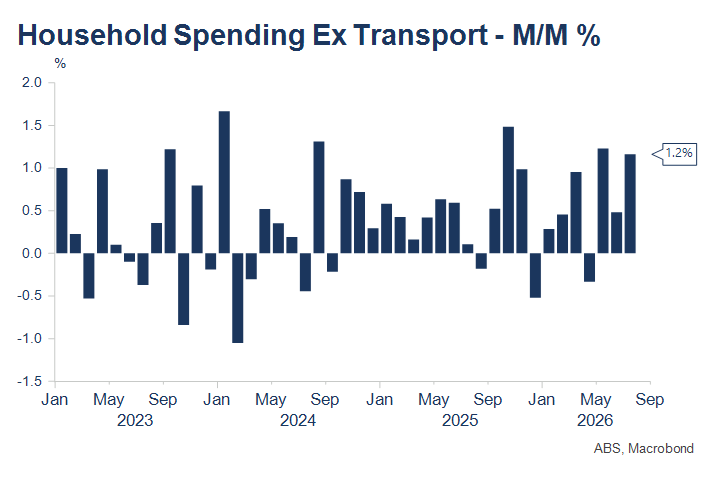
- 11:30am Household Spending Indicator (August). [Market expectation +0.3% m/m and +7.1% y/y; previous +1.1% m/m and +7.0% y/y].
- 02:30pm RBA Cash Rate Announcement [25bps increase expected. Key will be any indications of the likelihood of a quick follow-up rate increase].
- 03:30pm RBA Governor Press Conference
- Midnight US JOLTs Job Openings Survey (August). [Forecast 7225K; previous 7271K].
Wednesday 30 September
- 03:00am Fed’s Goolsbee speaks
- 04:00am Fed’s Williams speaks
- 11:30am Australian CPI (August). [Headline expected +0.5% m/m, 4.1% y/y; previous +1.0% m/m, +3.5% y/y. Trimmed mean expected +0.3% m/m, 3.6% y/y; previous +0.5% m/m, 3.6% y/y – risks to the upside given petrol price rises through July and August].
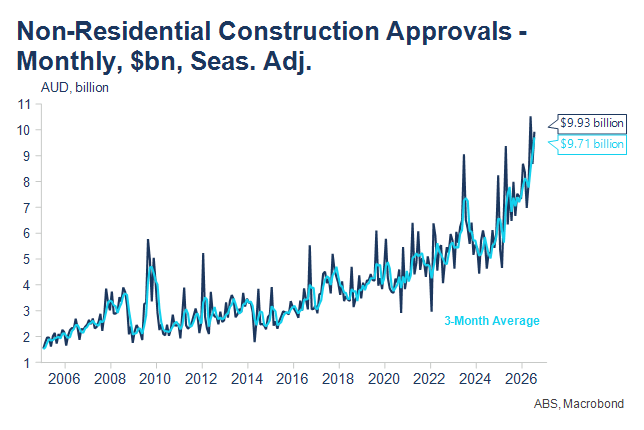
- 11:30am Building Approvals (August). [Expected -1% m/m, previous -3.6% m/m. Focus should be on non-residential construction approvals given this is where the data centre boom shows up in the Australian data: previous $9.93bn].
- 10:30pm US PCE deflator (August). [core expected +0.3% m/m, 3.3% y/y; previous +0.2% m/m, 3.3% y/y].
Thursday 1 October
- 03:30am Fed’s Barkin speaks
- 05:25am Fed’s Cook speaks
- 07:10am Fed’s Goolsbee speaks
- 08:00am Fed’s Kashkari speaks
- 30am RBA’s Financial Stability Report
- 07:30pm Challenger Layoffs (August)
- 10:30pm Initial Jobless Claims [previous +197K]
- 11:05pm Fed’s Barkin, Collins and Schmid appear on panel
- Midnight Manufacturing ISM (September). [Expected 55.0, previous 54.6; Prices Paid expected 72.0, previous 71.1].
Friday 2 October
- 05:30am Fed’s Cook and Williams panel appearance
- 08:45am Fed’s Logan speaks
- 11:00am $1.2bn 4.5% 2033 bond tender
- 10:30pm Non-Farm Payrolls (September). [Payrolls expected +100K, previous +162K; Unemployment Rate expected 4.1%, previous 4.1% - risk better than expected prints].
As the calendar reflects, it’s a massive week for Australian and US data and events. Inflation updates from both countries will provide an indication of how quickly the renewed rise in oil prices is flowing more broadly into prices. The communications accompanying the RBA’s meeting on Tuesday will give insight into the thoughts of the broader Board. It’s also another big week for Fed speeches after last week’s deluge, which saw messages weighted towards further near-term tightening. There’s also a considerable number of US labour market indicators published. Last month’s data strongly suggested the likelihood of stronger payrolls data in coming months, while the continued very low readings for initial jobless claims suggest downside risk for the US unemployment rate.
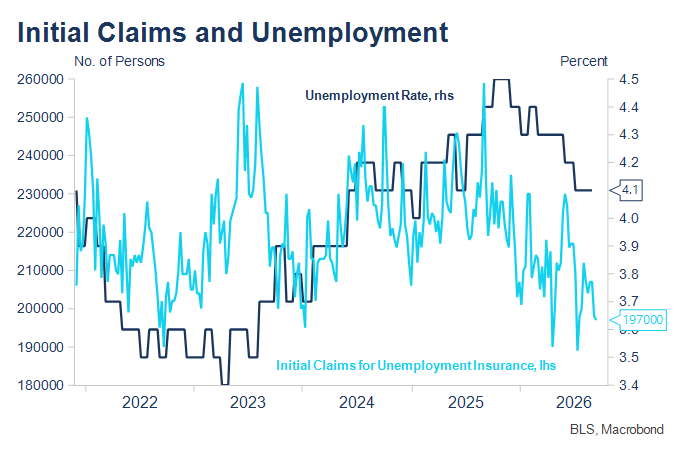
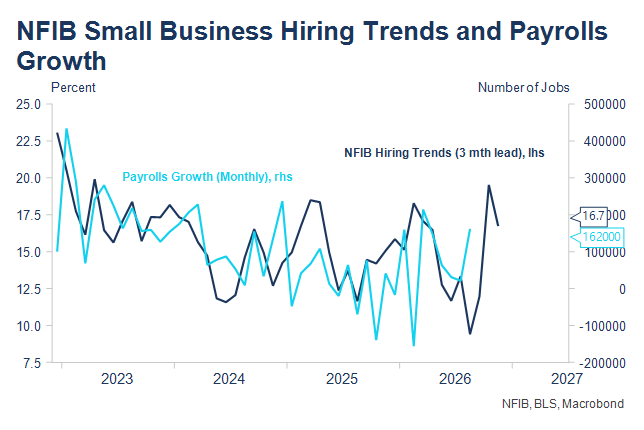
Importantly – and as signalled in many of the Fed speeches last week – if the labour market is sound, the Fed can focus more on its inflation challenge. That’s even more possible if the US labour market strengthens! The NFIB series has been excellent not only at picking the swings in payroll growth but also at giving a reasonable indication of the quantum of hiring. It suggests payrolls growth exceeding 150,000 is in prospect in coming months; a rate sufficient to lower the US unemployment rate. That’s likely to continue creating a bearish backdrop to the US and to an extent, global interest rates.
As noted earlier, the monthly trimmed mean Australian CPI appears to have some residual seasonality with the first month of the quarter typically printing higher than in the subsequent two months. That might suggest risk of a lower outcome for August, though this was not the case last August. In addition, this August, the market has the very strong rise in petrol, diesel and jet fuel prices to contend with, which suggests the risk is on the upside. The question for me is whether this shows up in the August or September CPIs, but either way it will be reflected in the September quarter CPI. The risk would seem to be of no less than the market forecast of 0.3% m/m, with the risk of a 0.4% m/m trimmed mean given the renewed rise in fuel prices. Neither outcomes are helpful for the Q3 CPI, which is published just ahead of the November RBA Board meeting.
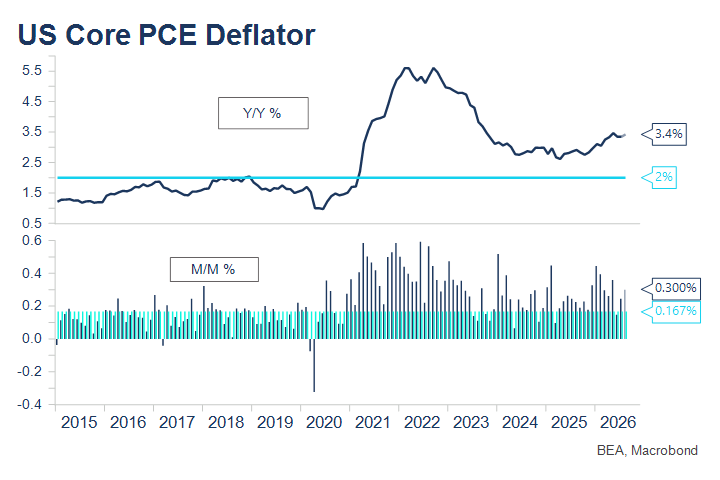
Core US PCE inflation is expected to record a 0.3% m/m increase in August (3.3% or 3.4% y/y). Such a print seems to still clearly fail Fed Chair Warsh’s requirement that inflation be clearly trending back to 2% in a timely fashion. That should see the next Fed rate rise occur in late October. Recent Fed speakers are placing greater weight on the frequency of recent supply shocks, the AI investment boom creating some demand pressures and their continuing failure to return inflation to target, which for most countries is now approaching the five year mark.
Australia’s Household Spending Indicator for August is also released on Tuesday. This indicator includes spending on fuel, which explains economist forecasts for another positive print even after the 1.1% m/m print in July. The latter was the third successive month that household spending had significantly exceeded forecasts. Whether that reflected stronger spending or higher prices, is somewhat irrelevant, as both confirm the RBA has more work to do. I continue to focus on Household Spending ex Transport to remove some of the impact of recent large variations in petrol prices. Recent higher diesel prices suggest higher general food and other retail prices will follow in coming months.
I also continue to have a keen interest in the non-residential construction approvals component from the Building Approvals release. This doesn’t seem to be closely followed by markets but is the best lead indicator of the scale of Australia’s data centre investment boom. Approvals have doubled in the past year and a $32bn project has recently been announced for Toowoomba in Queensland. It will also be very interesting to see if the drop in private sector house approvals last month marked a turning point for this series.
Outlook
My base has been the emergence of a long slow tightening cycle in both the US and Australia, driven by the AI investment boom. This leaves me modestly bearish on bond yields in both countries and trading from a ‘sell rallies’ rather than ‘buy dips’ perspective. That’s been correct recently, though the bond sell off has, if anything, been faster than I was expecting. In turn that likely reflects signs of stronger US economic growth. Hawkish Fed commentary has also been relevant, while this week might also see stronger US labour market data to boot. While the Australian economic data is not as strong as that of the US, Australian longer-term yields are likely to be negatively influenced by US term yield developments, though rise at a slower pace. In both Australia and the US, the likelihood remains that short end yields have a little further repricing to do as a further US rate increase at the next FOMC meeting in late October seems likely.